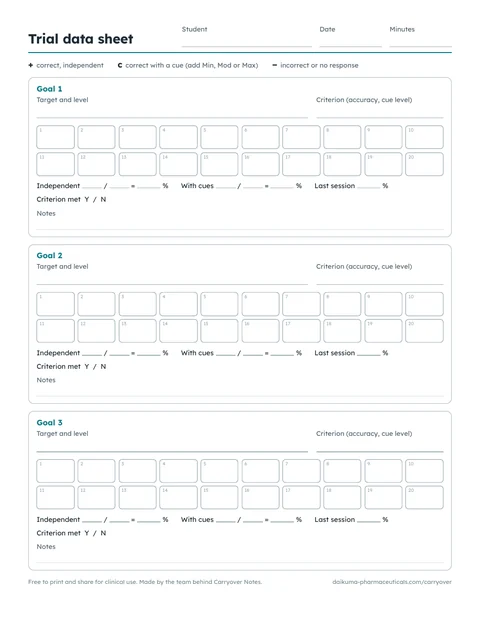
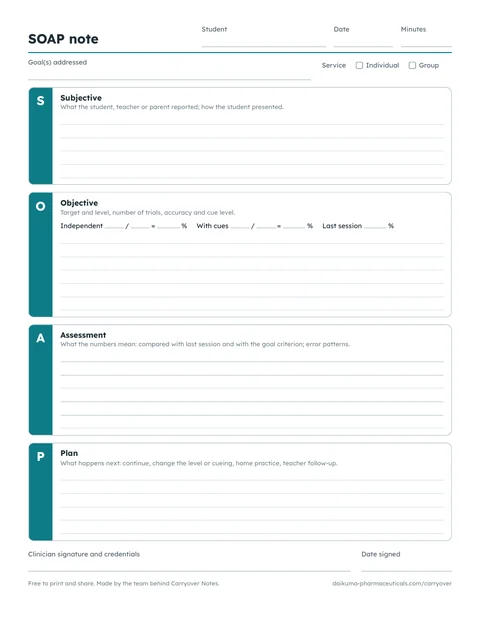
A free app privacy checklist for school SLPs
Before you use an app for student notes, your district’s technology or privacy office will probably have questions. Here are ten common ones on a single page: ask the vendor, write down the answers, and hand it over.
US Letter PDFs. No sign-up and no email address. General information, not legal advice.
The ten questions
These are the same ten that are printed on the checklist, with a line on why each one tends to come up.
Where is student data stored?
On the device only, on the vendor’s servers, or with a cloud provider? A specific answer is more useful than “in the cloud”.
Does the vendor receive any student information?
Including audio, transcripts, notes, names, and crash or diagnostic logs that might contain them. The answer should match the App Store privacy label.
Is an account required, and who can access the data?
An account means a stored identity and a login. If there is one, it is fair to ask who at the company can see the data.
Is data encrypted at rest and in transit?
At rest: unreadable when the device is locked or a server disk goes missing. In transit: is anything sent at all, and if so, over encrypted connections?
If the app uses AI, where does processing happen?
On the device, or on a vendor or AI-provider server? Is student data ever used to train models? Speech-to-text and note-writing tools differ a lot here.
Which third parties touch the data?
Analytics, crash-reporting and advertising tools are common in apps, and each one is another company handling data. A good answer lists them or says there are none.
How long is data kept, and how is it deleted?
At the end of the school year, when a clinician leaves the district, and when the app is deleted.
What happens if the device is lost?
The usual layers are a device passcode, file encryption, an in-app lock and, on district devices, remote wipe through mobile device management (MDM).
Can the district deploy and manage it?
For example through Apple School Manager and the district’s MDM, so the district keeps control of its devices and records.
Will the vendor sign a data privacy agreement or a written attestation?
A vendor that receives student data should be ready to sign your state’s data privacy agreement (DPA). One that receives none should be willing to say so in writing.
Why districts ask
Student records are covered by federal law, by state student-privacy laws and by district policy, so technology and privacy offices have to check before an app can hold them.
FERPA protects personally identifiable information in education records at schools that receive federal education funding. A school can share that information with an outside company without parental consent only under specific conditions, most often when the company acts as a “school official” with a legitimate educational interest, under the school’s direct control, and with limits on how the data is used.
State laws such as California’s SOPIPA, Illinois’ SOPPA and New York’s Education Law §2-d add rules for companies that collect or receive student data, and many districts require a signed DPA before staff use a tool that stores student information.
In practice, an app that sends student information to a company’s servers usually needs a review and a contract. An app that keeps everything on the device is a simpler conversation, though not an automatic yes: device security and district policy still apply.
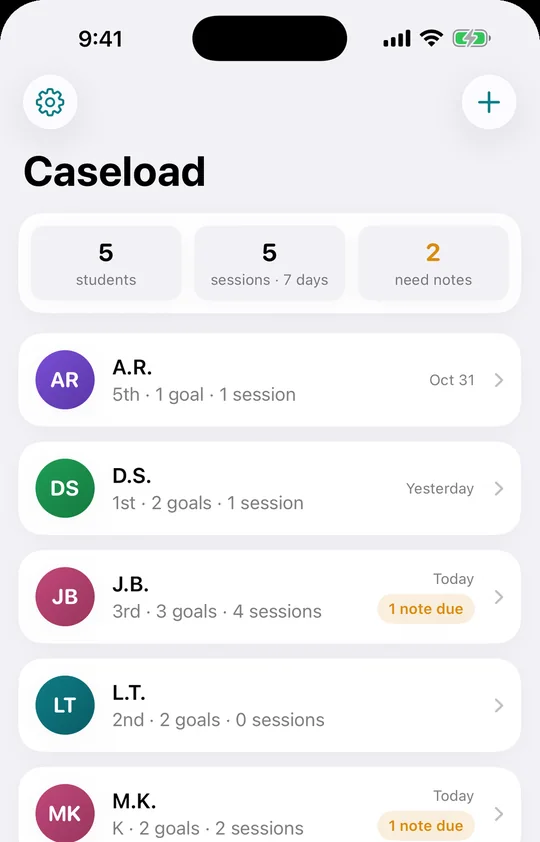
We make Carryover Notes, an iPhone app for school SLPs.
Our own answers, for Carryover Notes
Here is the checklist filled in for our app, so your IT team has something to check against. The App Store privacy label and our Security & Privacy Overview say the same thing.
| Storage | Only in the app on the clinician’s iPhone |
|---|---|
| Sent to us | Nothing. No server, no cloud sync; privacy label: Data Not Collected |
| Account | None |
| AI processing | Apple’s on-device models; nothing leaves the phone or is used for training |
| Third parties | No analytics, advertising or crash-reporting tools |
| Paperwork | We’ll sign a written attestation on request |